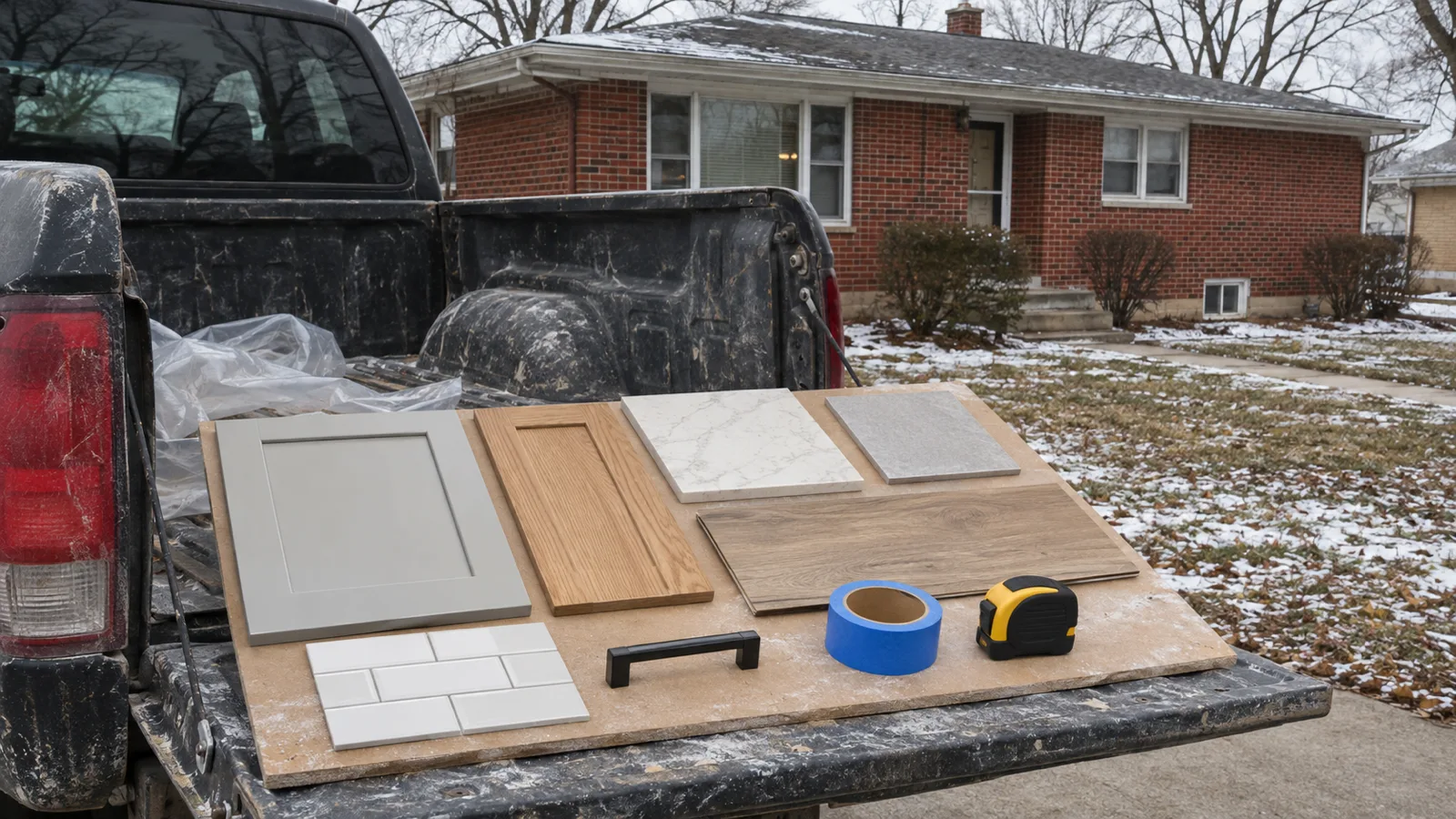
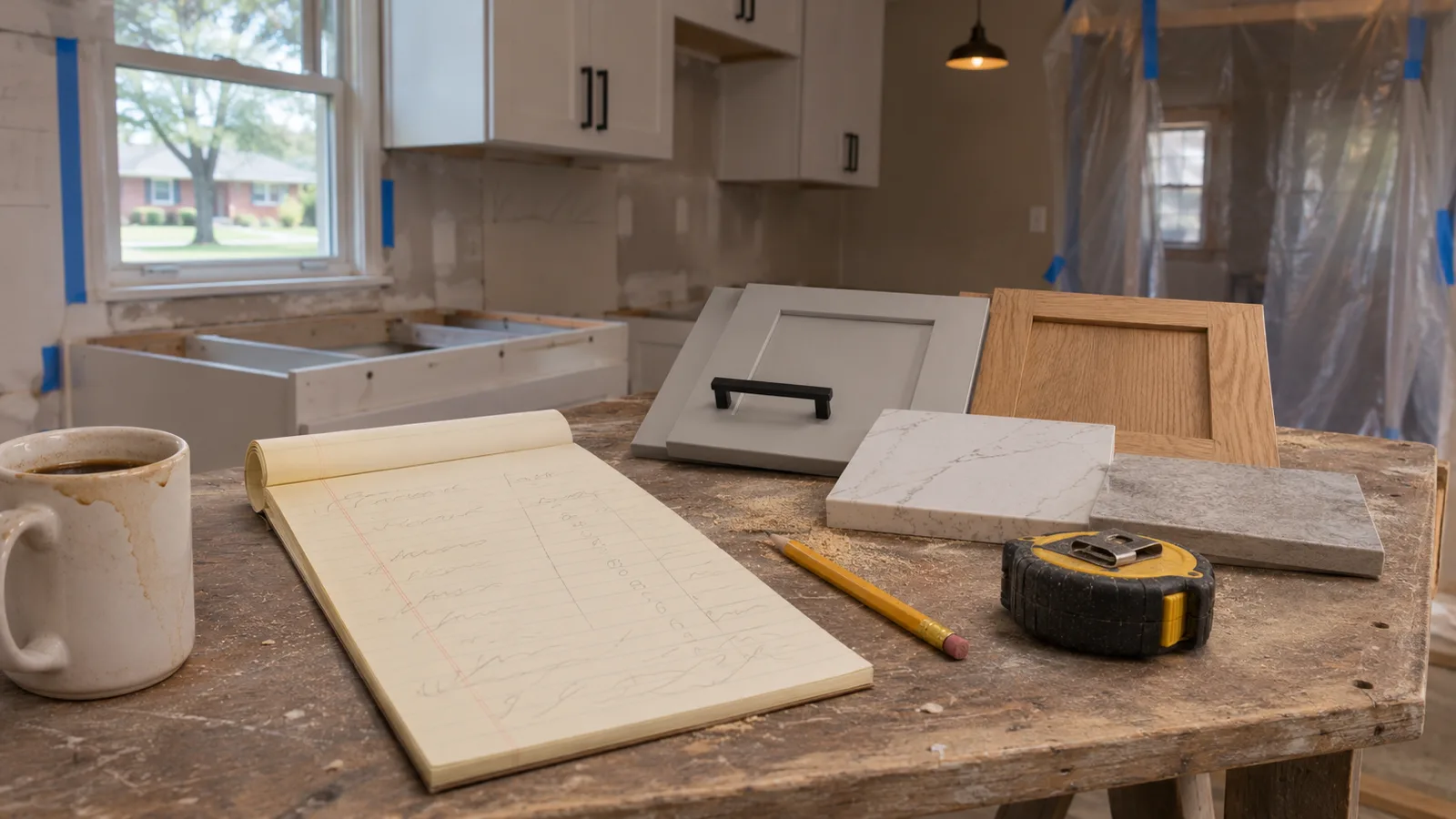
Hardwood vs Luxury Vinyl in an Ohio Kitchen: Which Lasts Longer Through Basement Humidity
An honest head-to-head on solid hardwood, engineered hardwood, and luxury vinyl plank in a Fairborn kitchen that sits on a slab with a half-basement under it. What cups, what holds up, and the moisture math nobody mentions at the big-box flooring counter.
Published · By Marcus Brennan
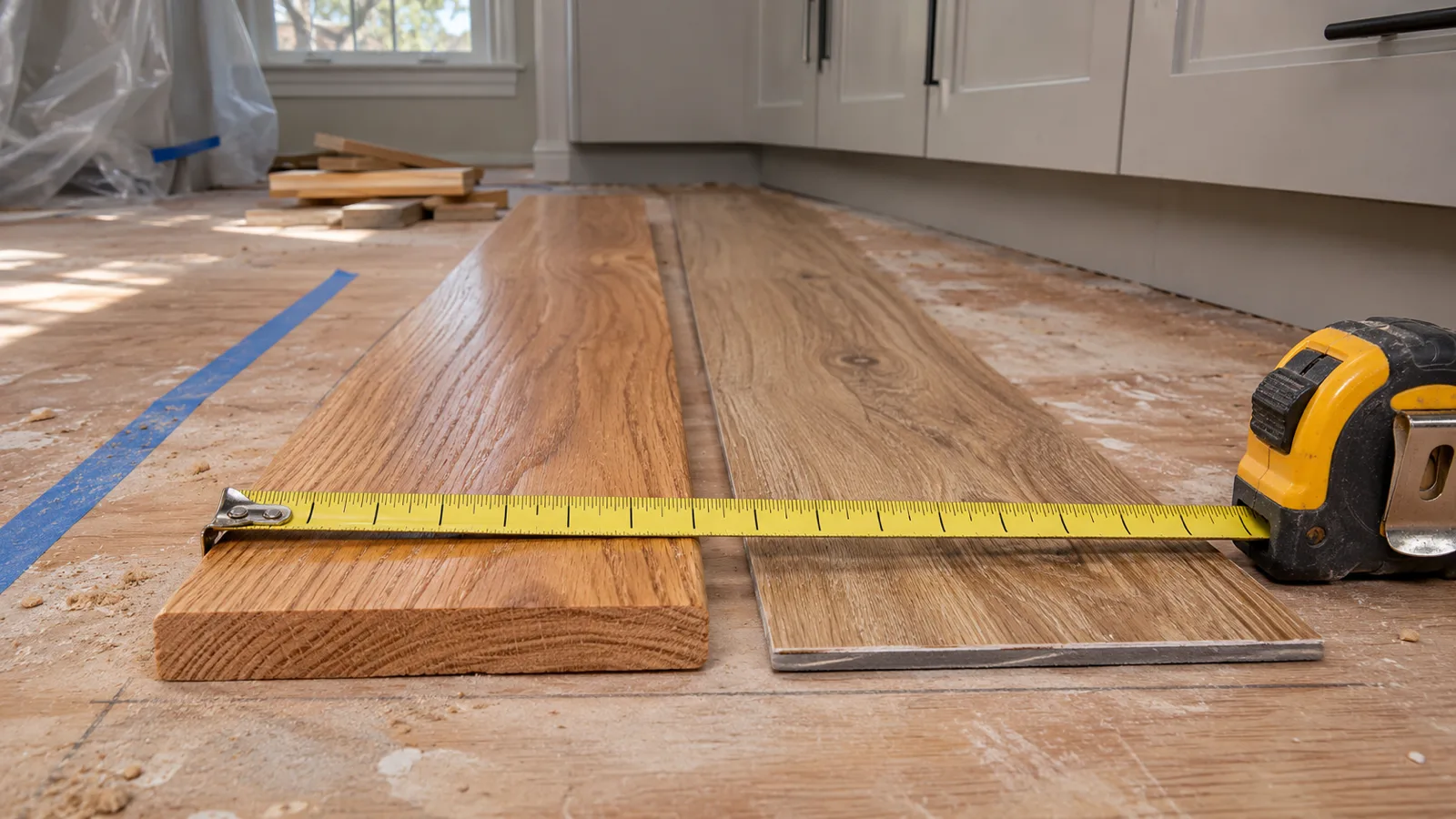
If you own a 1950s brick ranch in Osborn, a 1970s split-level in Wright View, or a 2000s build east of Fairborn-Enon Road, the flooring decision in your kitchen comes down to one question: how much moisture is coming up through the floor you cannot see? We run the calcium chloride test on every kitchen we remodel in Fairborn and the numbers surprise homeowners every time. Here is what we see, and what the test numbers mean for whether you should go hardwood or LVP.
What the moisture test actually shows
The 24-hour calcium chloride test measures pounds of water vapor passing through 1,000 square feet of slab in 24 hours. Flooring manufacturers set an upper limit for each product category: solid hardwood is only rated for 3 pounds, engineered hardwood is also 3 pounds, click-lock LVP with foam backing is 5 pounds, click-lock LVP with cork underlayment is 7 pounds, and glue-down tile with a moisture-rated mortar handles 9 pounds and up.
In Fairborn, our calcium chloride readings come back at: 1 to 2 pounds for homes with a full dry basement under the kitchen (rare, maybe 15 percent of our jobs), 3 to 5 pounds for the typical 1950s to 1980s Osborn ranch with a half-basement, and 5 to 8 pounds for slab-on-grade homes built before 1985 without a vapor barrier under the slab. That means: solid hardwood is a wrong answer for roughly 60 percent of Fairborn kitchens from day one. It will cup within 3 winters and you will replace it.
Why basement humidity in Fairborn is not the number people think
Basements in Dayton metro run surprisingly humid most of the year because the slab-perimeter drain tile in 1950s and 1960s builds was undersized, and the clay soil around Fairborn holds water against the foundation. We see basement humidity readings of 55 to 72 percent in July around the perimeter walls even in homes homeowners describe as dry. That humidity migrates up through the floor slab into the kitchen above by capillary action through any hairline crack in the concrete.
A 2,000-square-foot Fairborn ranch with a half-basement typically delivers 1.5 to 3 gallons of water vapor per day into the first floor through the slab. That is a lot of moisture for a wood floor to absorb and release across a Dayton year.
Solid hardwood in a Fairborn kitchen: we talk most people out of it
Solid 3/4-inch red oak looks beautiful, feels classic, and is almost always the wrong answer in a Fairborn kitchen over a slab or half-basement. Cupping is the failure mode: the bottom of each plank absorbs more moisture than the top, swells, and the edges rise. Within 3 winters you can feel the ridges when you walk barefoot. Within 6 winters the boards start splitting at the tongue.
The only Fairborn homes where solid hardwood works in the kitchen are the 1920s Craftsman stock along Herr Road and Main Street that sit on a full basement with a block wall and a dry crawl, and even there we recommend an extra moisture barrier under the subfloor. Cost for a solid hardwood kitchen install in Fairborn runs $14 to $22 per square foot.
Engineered hardwood: better, still risky over 4 pounds
Engineered hardwood is a plywood core with a hardwood wear layer on top, typically 3 to 7 mm of real oak or hickory. The plywood core is more dimensionally stable than solid hardwood, so it tolerates humidity swings better, but the manufacturer moisture spec is still 3 pounds. In Fairborn kitchens that test over 4 pounds, engineered will still cup, just slower, usually by year 5 instead of year 2.
Where engineered works: newer 2000s and 2010s builds east of Fairborn where the slab was poured with a proper vapor barrier and the moisture test comes back under 3 pounds. In those homes, engineered hardwood looks and feels like solid, costs $11 to $18 per square foot installed, and lasts the life of the kitchen. We spec it there happily.
Click-lock LVP with cork underlayment: our most-installed Fairborn floor
Click-lock luxury vinyl plank with an attached cork underlayment is what we install in roughly 70 percent of Fairborn kitchens now, including most of the 1950s Osborn ranch book. The cork does three things at once: it bumps the moisture tolerance from 5 pounds up to 7 pounds, it dampens the hollow sound that cheap LVP has over a slab, and it bridges minor slab imperfections so the floor feels solid underfoot.
LVP visually matches hardwood close enough that most homeowners at a kitchen-table conversation 8 feet away cannot tell the difference. It takes snow-salt from a boot without staining, handles a dishwasher drip without cupping, and if a plank gets scratched by a dog claw or a dropped cast-iron skillet, we can swap that single plank in 20 minutes without pulling the whole run. Cost in Fairborn runs $7 to $12 per square foot installed.
Porcelain tile: the bombproof answer nobody wants to install
Porcelain tile over a mortar bed with a moisture-rated membrane handles 9+ pounds of slab moisture, lasts 30+ years, and takes abuse like no other kitchen floor. The downsides: it is cold underfoot in a Fairborn January without radiant heat, grout joints need epoxy grout to stay clean, and the install costs more up front, $14 to $24 per square foot. We install porcelain on about 1 in 10 Fairborn kitchens, mostly for homeowners who hate replacing floors and want the one-and-done option.
Our Fairborn flooring playbook, by housing stock
Here is what we spec most often, broken out by the housing era:
1950s brick ranches in Osborn, Park Hills, Garrison Ave: click-lock LVP with cork underlayment, moisture test required before quote.
1920s Craftsman along Main Street and Herr Road: engineered hardwood over the full basement, LVP over the kitchen wing addition.
1970s to 1980s split-levels in Wright View and off Trebein Rd: click-lock LVP over the raised kitchen slab, moisture test required.
2000s and 2010s builds east of Fairborn-Enon Rd: engineered hardwood if the moisture test comes back under 3 pounds, otherwise LVP.
Bottom line
Solid hardwood in a Fairborn kitchen is a status symbol, not a durability choice. Engineered hardwood works in newer builds with modern slab vapor barriers. Click-lock LVP with cork underlayment is the pragmatic answer for 70 percent of Fairborn kitchens and the floor we install most often. Porcelain tile is bombproof but cold. The right answer depends on your slab moisture reading, and we run the test free on every flooring quote.
If you want the moisture reading on your 45324 kitchen before you commit to a flooring budget, give us a call and we are at your door within 48 hours.