Kitchen Remodeling Cost Guide for Fairborn OH Homes
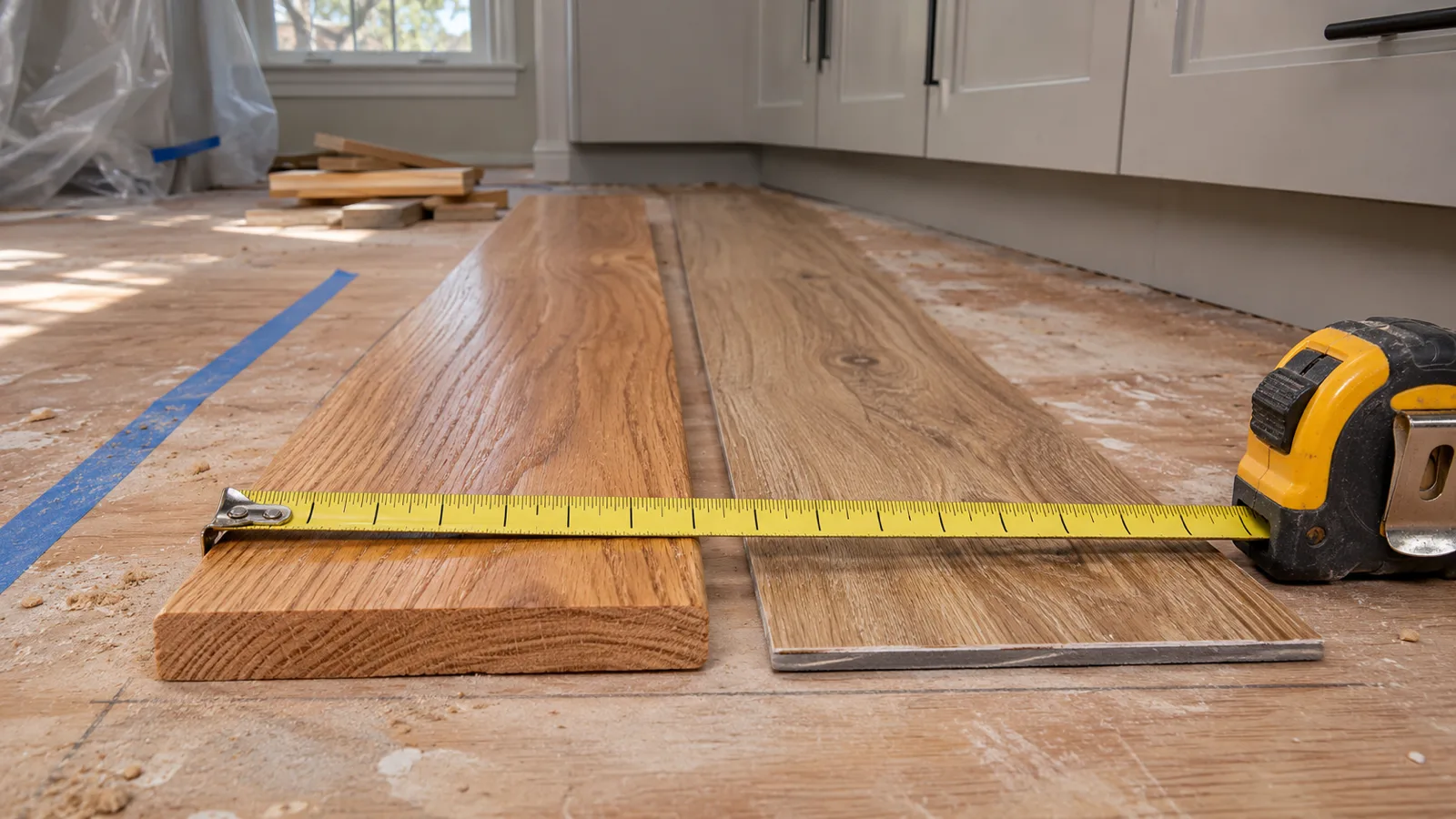
Luxury vinyl plank lasts longer than engineered hardwood in most Ohio kitchens, but that is not the full answer. Here is when each one actually wins in a Fairborn home.
Published · By Marcus Brennan
Luxury vinyl plank (LVP) lasts 15 to 25 years in a Ohio kitchen. Engineered hardwood lasts 10 to 20 years here, IF your slab passes the moisture test. Solid hardwood does not belong in a Ohio kitchen, full stop. For most Fairborn kitchens, the right pick between engineered wood and LVP depends on three things: your slab moisture reading, how much you cook, and how much you want the look of real wood.
Why not solid hardwood in a Ohio kitchen?
Solid wood moves. In Fairborn humidity cycles (60% in dry winter, 85% in August), a 5-inch-wide solid-oak plank can expand and contract 3/32 of an inch across the width every season. In a kitchen, that movement opens gaps at every joint, and water from a dropped glass or a dishwasher leak seeps in. Within 2 to 4 years you see cupping, crowning, or black mildew lines along the joints. We do not install solid hardwood in Fairborn kitchens, and any contractor who does is setting you up for a warranty claim.
Which is more durable in Dayton freeze-thaw, engineered hardwood or LVP?
LVP wins on pure moisture tolerance. It absorbs near zero moisture, tolerates humidity swings fine, and survives a short-term leak without damage. Engineered hardwood has a real-wood top layer (2 to 4 mm) glued to a plywood or HDF core. The top layer still moves with humidity, just less than solid wood. In 75 to 85% indoor summer humidity (standard for a Fairborn house without aggressive A/C), engineered oak and hickory hold up for 10 to 20 years. Longer if you keep the humidity dialed in with your A/C running 24/7, shorter if the home sits empty for weeks at a time with the system off.
The real durability gap shows up in day-to-day use. Drop a cast-iron pan on LVP, you dent the plank and the dent stays. Drop the same pan on engineered hardwood, you dent the top wood layer, which can be sanded or spot-refinished. So engineered wood is more repairable, LVP is less damageable to begin with. Pick your poison.
What does the slab moisture test say?
This is the question most installers skip and it changes the right answer. Run a 24-hour calcium chloride test on your slab before you buy anything. The test kit costs $20 and tells you how much moisture the slab is giving off per 1,000 square feet per 24 hours.
Under 3 pounds: engineered hardwood or LVP, pick on aesthetics and feel.
3 to 5 pounds: click-lock LVP with attached underlayment, OR floating engineered hardwood with a vapor barrier underlayment. Avoid glue-down anything.
5 to 7 pounds: LVP with a cork or IXPE underlayment rated for vapor emission. Engineered hardwood is risky here. These are common readings in pre-1995 Fairborn homes off Park Hills and in the Cedar Creek pocket that lack a proper vapor barrier.
Over 7 pounds: porcelain tile only, or investigate the slab for cracks or groundwater intrusion before spending on any new flooring.
Which is cheaper?
LVP wins by about 35 to 45% on installed cost. In Fairborn right now:
LVP: $6 to $9 per installed square foot. A 200-square-foot kitchen is $1,200 to $1,800.
Engineered hardwood: $10 to $14 per installed square foot. The same kitchen is $2,000 to $2,800.
If your slab needs self-leveling compound before hardwood (common on older Fairborn ranch homes), add $300 to $800. LVP tolerates minor slab dips better, which widens the cost gap.
Which looks better in a Fairborn kitchen?
Depends on the kitchen's era and your expectations. For Park Hills and Greene Crossing post-2000 builds and open-plan modern remodels, engineered white oak or hickory is beautiful and blends right into the great-room flooring. The real wood has a depth that LVP cannot fake at any price.
For Park Hills ranch homes with settled slabs and seasonal rentals, wood-look LVP in oak or hickory tones is the practical pick. Looks 85% as good at 65% of the cost, no moisture risk, no refinishing. We install it running the same direction as the great-room flooring with no transition strip (just a stable expansion gap under the baseboard), which makes small Fairborn kitchens feel bigger.
Which handles a dishwasher leak better?
LVP by a wide margin. Water that sits on LVP seams for over 48 hours can seep underneath, but click-lock LVP with a proper underlayment survives a short-term leak if you dry it out fast. The $25 water-leak detector under the sink from Home Depot is the single best investment you can make for either floor type.
Engineered hardwood is much more vulnerable. The real-wood top layer wicks moisture, the plywood core delaminates under sustained wet exposure, and once that happens the plank has to be replaced (and the replacement rarely matches the color of the aged planks around it). On homes that sit empty for weeks (common Fairborn snowbird pattern), LVP is the safer pick.
When should I pick LVP?
If you have an older Fairborn home with a settled slab or a slab that reads 5+ pounds on the moisture test, want cushioning underfoot, cook casually, have pets, are a snowbird who leaves the house empty for months, or want to match an open-plan to the great room. LVP is the Fairborn default for good reason. See our kitchen flooring installation page for the full install process.
When should I pick engineered hardwood?
If your slab passes the moisture test under 3 pounds, you live in the house year-round so the A/C is always running and humidity stays dialed in, you want the look and feel of real wood, and you are OK with a floor that needs occasional refinishing over its life. Park Hills homes are usually the sweet spot for engineered hardwood.
DIY vs when to call
LVP click-lock is one of the most DIY-friendly floors on the market. If you can rent a tapping block and measure a room, you can lay LVP over an existing flat slab in a weekend. What will stop a DIY: slab leveling (self-leveling compound has a short working time and an uneven pour can wreck a floor), engineered hardwood glue-down (the trowel work is a real trade skill), and anything that involves moving the dishwasher or fridge back into place without damaging the new floor. We handle the hard parts and leave the easy DIY to you if you want to save labor cost. See our kitchen layout and design page for the full planning process.
What to avoid
Solid hardwood in a Ohio kitchen (will cup within 4 years). Peel-and-stick LVP (as opposed to click-lock). Adhesive fails in Dayton freeze-thaw within 3 to 5 years. Thin-wear-layer LVP (under 12 mil). Any high-traffic Fairborn kitchen chews through it in 5 to 7 years. Buy 20 mil wear layer or better. Glue-down anything on a slab that reads over 3 pounds, you are gambling on a failure in year 3 or 4.
Bottom line
Engineered hardwood is beautiful in a Fairborn kitchen if your slab passes and you live in the house full time. LVP is the practical pick for everyone else, and especially for pre-1995 ranch homes and snowbird properties. Run a slab moisture test before buying either. Spend the $50 upgrade on cork underlayment if you go LVP on an older slab. Spend the $300 upgrade on 20-mil wear layer either way.
If you want us to measure your kitchen, run the slab test, and give you a written quote for both options, we're a 48-hour visit away in Fairborn 34272.